


Lovable is an AI-powered software development platform that generates full-stack web applications from natural language prompts. You describe the application you want, and Lovable writes the frontend, provisions the database, wires up authentication and deploys the result. Unlike early coding assistants that returned snippets, it produces a complete, working codebase in a single workflow.
The Stockholm company behind it was founded in 2023 and is now one of Europe’s fastest-growing software businesses: $400 million raised at a $13.3 billion valuation in August 2026, and more than 60 million projects built since launch. All figures below are current as of August 2026.

What is Lovable?
Lovable is a text-to-app platform created by the team behind GPT Engineer, the open source project started by co-founder and CEO Anton Osika. It works as an autonomous software engineer: you give it a high-level instruction such as “build a CRM for real estate agents”, and it returns a deployed, functional application.
Lovable is not a language model itself. It is an orchestration layer that runs frontier models from several providers and adds the engineering scaffolding around them: file management, database migrations, deployment, testing and error recovery. It added Claude Opus 5 in July 2026 for complex, multi-step code generation and says it will keep drawing on multiple models.
What is Lovable used for?
Three uses dominate: prototypes and MVPs, to validate an idea before committing engineering budget; internal tools such as dashboards and admin panels stuck at the bottom of an IT backlog; and customer-facing web apps, increasingly with payments attached through built-in Paddle and Stripe support.
Key technical specifications
Lovable imposes an opinionated but industry-standard tech stack. The output is normal code that a human developer can read, review and maintain.
- Frontend: TanStack Start, built on React, TypeScript and Tailwind CSS. It replaced the older React and Vite setup as the default for new projects on 13 May 2026, and renders each page into finished HTML on the server so visitors, search engines and AI crawlers receive the same complete page. Existing React and Vite projects can be upgraded in place.
- Backend: Lovable Cloud, providing a PostgreSQL database, authentication, file storage, realtime and edge functions. It is enabled by default and built on Supabase‘s open source foundation.
- Hosting: managed hosting with SSL and custom domains, plus two-way GitHub or GitLab sync.
- AI models: multi-model orchestration, including Claude Opus 5 since July 2026.
What database does Lovable use?
Lovable Cloud gives every project a managed PostgreSQL database with row-level security, storage and serverless functions, administered from the Cloud tab inside Lovable. Teams that want to own the infrastructure can connect their own Supabase project instead, which moves billing and administration to the Supabase dashboard but gives up built-in payments. There is no one-click migration, so decide at the start of a project.
Core capabilities and workflow
Lovable operates through a conversational interface where you describe features, bugs or design changes, and applies updates across multiple files at once.
Full-stack generation (backend integration)
Most AI builders focus on the user interface. Lovable extends this to the backend: asking for “a dashboard where users can only see their own data” triggers the creation of:
- A database table with a user_id column.
- Row-level security (RLS) policies in PostgreSQL.
- React components that fetch data based on the authenticated session.
Visual editing, Plan mode and Build mode
The platform separates thinking from doing:
- Plan mode works out an approach before any code is written, and you can highlight part of a plan and say what should change. It costs a flat 1 credit per message.
- Build mode implements and verifies changes end to end: it explores the codebase, edits across files, reads logs and runtime output, and runs browser tests on request.
- The preview toolbar, which replaced the older Visual Edits panel, lets you click elements in the live preview to change them, edit text inline or leave comments. Inline text edits are free up to 100 per user per day; selecting elements consumes credits.
Code ownership and export
Vendor lock-in is a primary concern. Users keep full ownership of the generated code. Code Mode lets paid users browse, edit and download the whole codebase as a zip, and manual edits do not consume credits. Two-way GitHub and GitLab sync works on every plan, so a development team can pull the project into its own repository and continue in a normal IDE without refactoring.
Pricing model analysis
Lovable bills in credits, and consolidated its separate build, Cloud and AI balances into one balance in June 2026. That single balance now covers building the app, hosting and running it on Lovable Cloud, and any AI features inside the deployed app.
- Free: 5 credits per day, capped at 30 per month. Git sync included, code editor read-only.
- Pro: from $25 per month for 100 monthly credits, scaling to $2,250 for 10,000. Adds code editing, custom domains and user roles.
- Business: from $50 per month for 100 monthly credits, scaling to $4,300 for 10,000. Adds SSO, security center and role-based access.
- Enterprise: custom, volume-based pricing with publishing controls, SCIM and audit logs.
Paid plans also get 5 daily credits with no monthly cap, unused monthly credits roll over while the subscription is active, and top-ups cost $0.30 per credit on Pro and $0.60 on Business.
Cost efficiency note: a credit is priced by the work, not the number of files touched. Lovable’s own examples put “make the button gray” at 0.50 credits, “add authentication with sign up and login” at 1.20 and a landing page with generated images at 1.70. More predictable than token metering, but heavy debugging burns credits faster than the headline numbers suggest.
Security and enterprise governance
This is the part of the category that has changed most. In 2025, researchers found Lovable-generated apps frequently shipped with misconfigured row-level security, exposing data through the public API. The issue was catalogued as CVE-2025-48757 with a critical rating, which the vendor disputed on the grounds that customers are responsible for their own application data.
Two scanners now ship with the platform. A basic scan lints RLS policies, reviews the database schema and audits dependencies for known vulnerabilities, and runs automatically when you open the publish dialog. A deep scan reviews access control, unauthenticated endpoints and exposed secrets, and can be scheduled across projects on Enterprise plans. Lovable holds SOC 2 Type II and ISO 27001:2022 certification, offers a DPA under GDPR, and supports SSO, SCIM provisioning, audit logs and regional data residency. Automated scanning reduces obvious mistakes, but it does not replace a security review before anything handling personal or financial data goes live.
Comparison: Lovable vs. Cursor vs. Bolt vs. v0
The market for AI development tools has split into distinct categories, from app generators to AI-native IDEs.
| Feature | Lovable | Cursor | Bolt.new | v0 (Vercel) |
|---|---|---|---|---|
| Type | Text-to-app platform | AI-native code editor (IDE) | Browser-based cloud builder | Full-stack app builder |
| Primary workflow | Chat to full app | Coding plus autonomous agents | Chat to full app | Chat to full app |
| Tech stack | TanStack Start, React, TypeScript | Agnostic (any language) | Node.js (WebContainers) | Next.js, Tailwind, shadcn/ui |
| Backend | Lovable Cloud, built in | Manual, user defined | Bolt Cloud | Connects to your database |
| Best for | Founders, internal tools, rapid MVPs | Professional developers, large codebases | In-browser building, quick builds | Teams already on Vercel and Next.js |
| Environment | Browser (no setup) | Local desktop (VS Code fork) | Browser (no setup) | Browser (no setup) |
Analysis of Lovable competitors
- Lovable: best when you need a working application with data persistence immediately. It handles database, authentication and hosting automatically, and goes furthest on enterprise governance.
- Cursor: a different category rather than a direct rival, and the standard for professional engineers. It runs locally as a VS Code fork, works in any language, and is strongest for maintaining large existing codebases. It moved to usage-based billing in 2025 and was acquired by SpaceX in 2026.
- Bolt.new: similar in shape to Lovable, running in a browser-based Node environment. Bolt Cloud closed most of the backend gap, so the choice comes down to workflow and governance rather than capability.
- v0: no longer UI-only. Vercel repositioned it as a full-stack builder that plans, generates a database and API, imports any GitHub repository and deploys. The natural pick for teams already on Next.js.
Replit targets the same audience with a broader cloud IDE, Figma Make is a prompt-to-app tool that also builds on existing Figma designs, and Base44 now sits inside Wix.
Practical application: Building an internal tool with Lovable
Lovable serves as a rapid prototyping engine for internal tools.
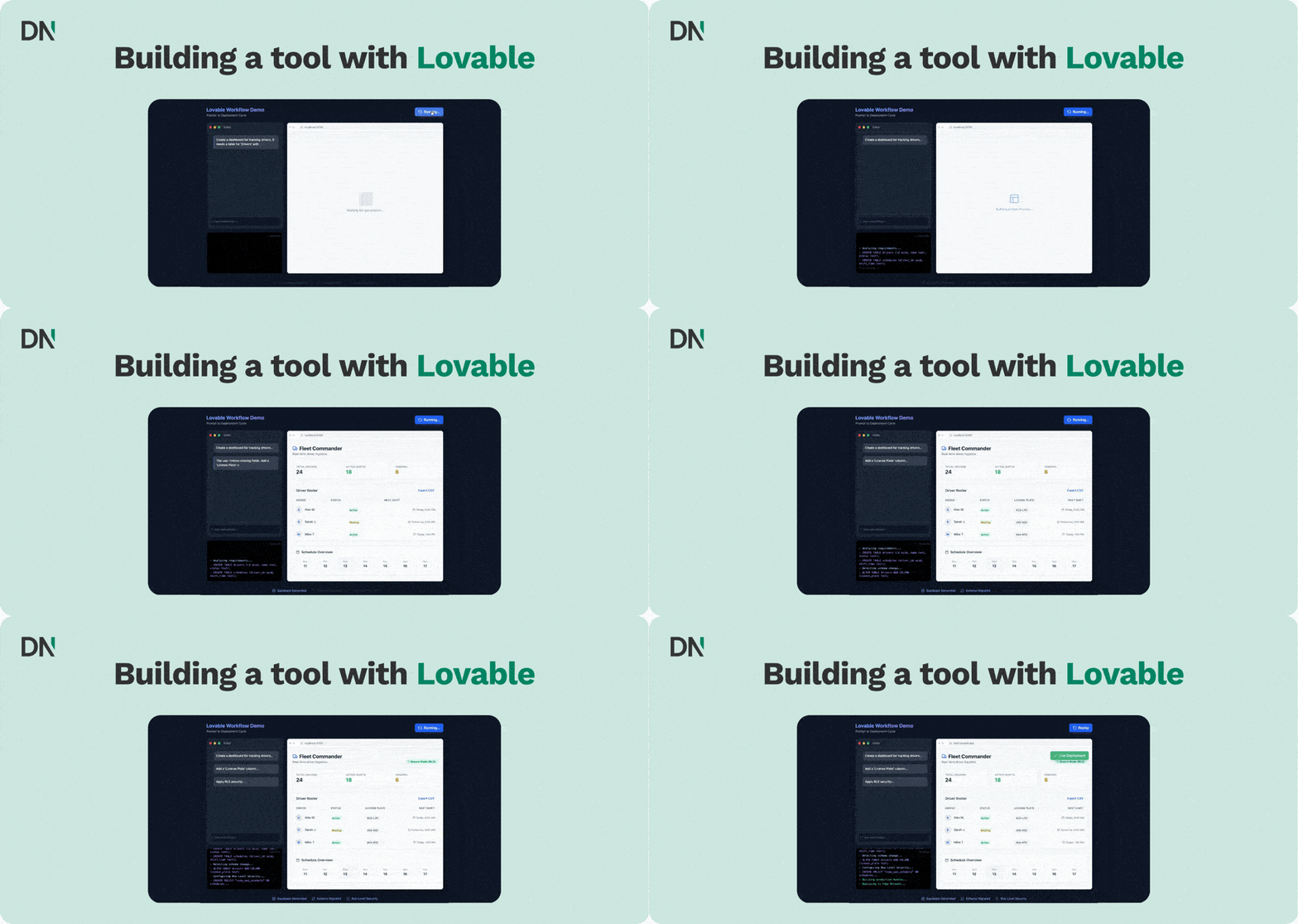
Scenario: a logistics company needs a dashboard to track driver schedules.
- Prompt: “Create a dashboard for tracking drivers, with a ‘Drivers’ table for name and status and a ‘Schedule’ table linked to drivers. Add a calendar view.”
- Generation: Lovable writes the frontend and provisions the relational tables in Lovable Cloud.
- Refinement: “Add a ‘License Plate’ column to the driver table.” Lovable runs the migration and updates the form.
- Security: “Make sure drivers can only see their own schedule.” Lovable applies the RLS policy, and the basic scan checks it before publishing.
This removes the setup cost of development environments and boilerplate. For complex enterprise integrations such as a legacy ERP system, a traditional development team or a custom AI solution is still needed to bridge the gap.
Conclusion
Lovable represents a shift from code completion to app generation. By handling the full stack, including database, authentication, payments and hosting, it lets teams validate ideas without immediate engineering overhead, and the past year of certification work has made it defensible inside larger organisations. Two things decide whether it works for you: how precisely you can describe technical requirements, and whether someone reviews the output before it reaches production.
Frequently Asked Questions (FAQ) about Lovable
What programming language does Lovable use?
Lovable generates TypeScript, which runs as JavaScript in the browser. New projects default to the TanStack Start framework built on React, with Tailwind CSS for styling and PostgreSQL on the backend.
What AI model or LLM does Lovable use?
Lovable is not an LLM and does not run a proprietary model of its own. It orchestrates models from several providers behind its own agent, and added Claude Opus 5 in July 2026 for complex code generation. The separate AI connector for features inside your own app offers Google Gemini and OpenAI GPT models.
What database does Lovable use and where is my data stored?
Every project gets a managed PostgreSQL database through Lovable Cloud, built on Supabase’s open source foundation. You can connect your own Supabase project instead, and Enterprise customers can keep code in GitHub Enterprise with regional data residency.
Does Lovable own the code it generates?
No. Users retain full ownership. Paid plans can download the entire codebase and two-way GitHub or GitLab sync works on every plan, so you can host the code anywhere or hand it to a development team.
Is Lovable free to use?
There is a free tier with 5 credits per day, capped at 30 per month, and a read-only code editor. Continuous development, code editing and custom domains require a paid plan, starting at $25 per month.
Can I use Lovable for a production SaaS application?
Yes. The backend runs on PostgreSQL and scales, and built-in Paddle and Stripe support covers subscriptions and one-off payments. Complex business logic still needs manual engineering, and anything handling personal or financial data should get a security review first.
Can Lovable be governed for enterprise use?
Yes. Enterprise plans add SSO with OIDC and SAML 2.0, SCIM provisioning, role-based access, audit logs, publishing restrictions and scheduled security scans, backed by SOC 2 Type II and ISO 27001:2022 certification and a DPA under GDPR.
How does Lovable differ from no-code tools like Bubble?
Bubble uses a proprietary visual editor and hosting environment, so leaving it means rebuilding. Lovable generates standard code that runs anywhere, which is the practical difference between a no-code platform and an AI development tool.
Does Lovable integrate with external APIs?
Yes. You can instruct Lovable to call third-party APIs from within the application logic, and it manages the secrets for you. For complex integrations, pointing the agent at the right API documentation makes a real difference.


